
Ant Colonies as Superorganisms: How Ants Communicate to Run the Nest
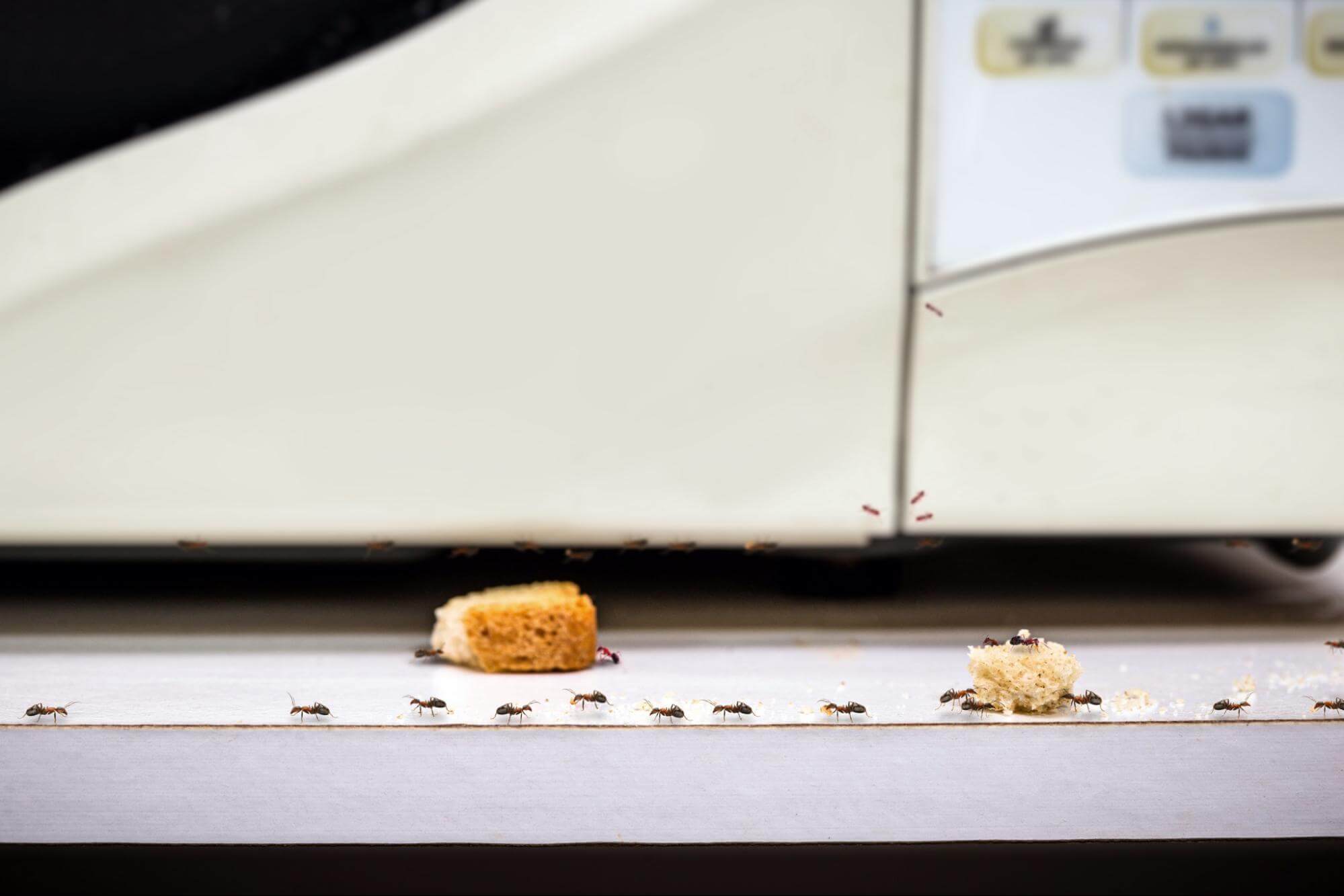
The line of ants crossing your kitchen counter looks like a group of insects that found some sugar. It isn’t.
It’s the visible output of a decision-making system that stretches back into your wall void, and the line itself is the least important part of it.
Understanding how ants communicate explains something most homeowners learn the hard way: you can wipe that line away every morning for a month, and the ants will still be there in June. Here’s what’s actually running underneath it.
The Colony Is the Organism
Biologists Bert Hölldobler and E.O. Wilson made the case in their 2009 book The Superorganism that an ant colony is best understood not as a group of animals but as a single distributed one. The castes function like organ systems – workers forage and build, soldiers defend, the queen reproduces. No individual ant is viable alone, and none makes decisions in any meaningful sense. A single ant is closer to a cell than to an animal.
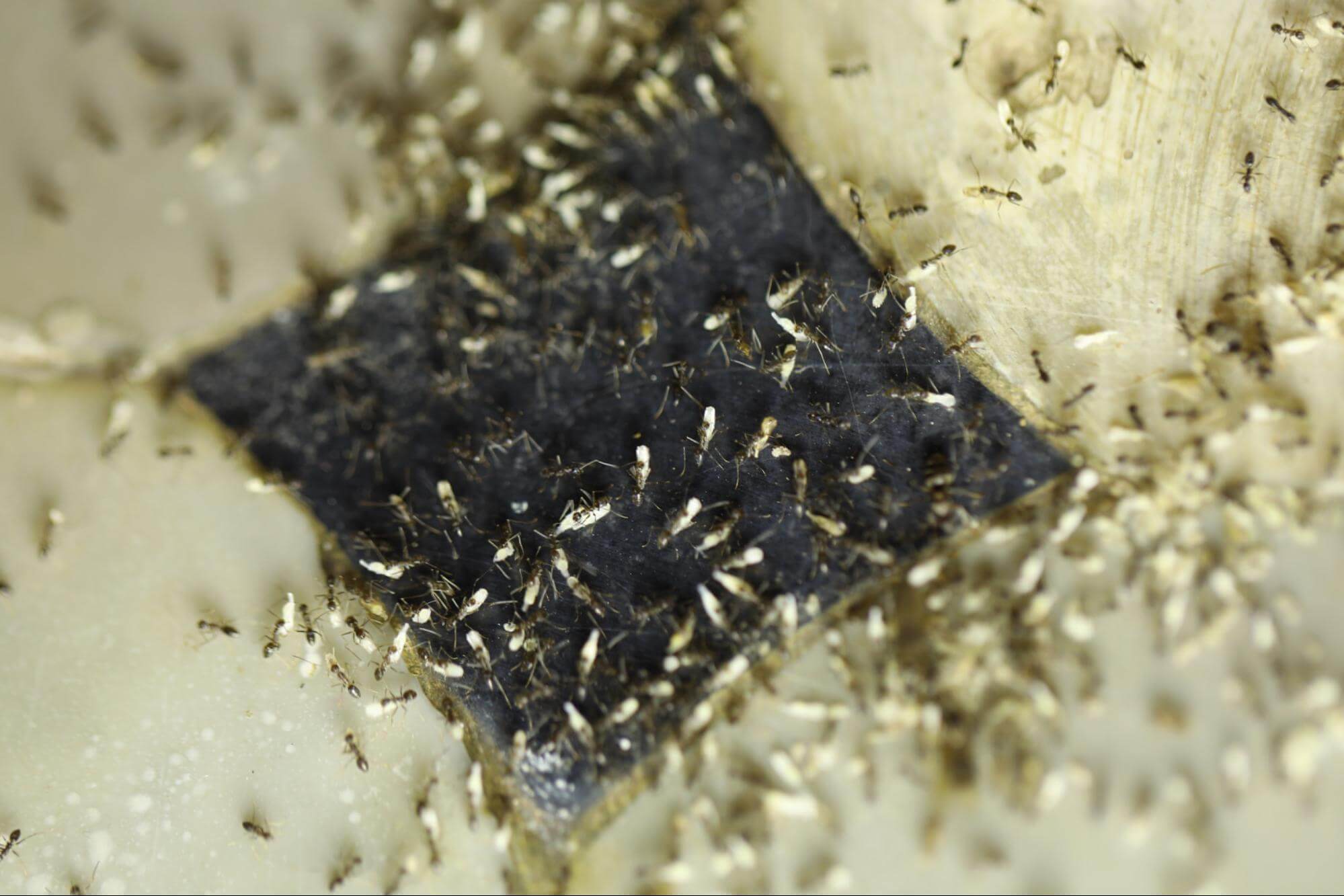
The scale is easy to underestimate. Texas A&M AgriLife notes that pharaoh ant colonies range from “a single queen with a few hundred workers” up to “hundreds of queens with several thousand workers,” spread across many connected nests whose members “move freely” between them.
That’s the thing in your wall. The twelve ants on the counter are a rounding error.
How Do Ants Communicate?
Almost entirely through chemistry. Ants are functionally blind by our standards, and they compensate with a chemical vocabulary produced by several specialized glands – Dufour’s gland, the venom gland, the mandibular glands, and glands in the legs – each contributing different signals.
Those chemical messages are supplemented by three physical channels: touch, mostly antennae tapping; stridulation, producing vibrations by rubbing body segments; and trophallaxis, the mouth-to-mouth exchange of food and fluid between workers.
Hold onto that last one. Trophallaxis is why professional ant control works at all.
Trail Pheromones Are a Voting System
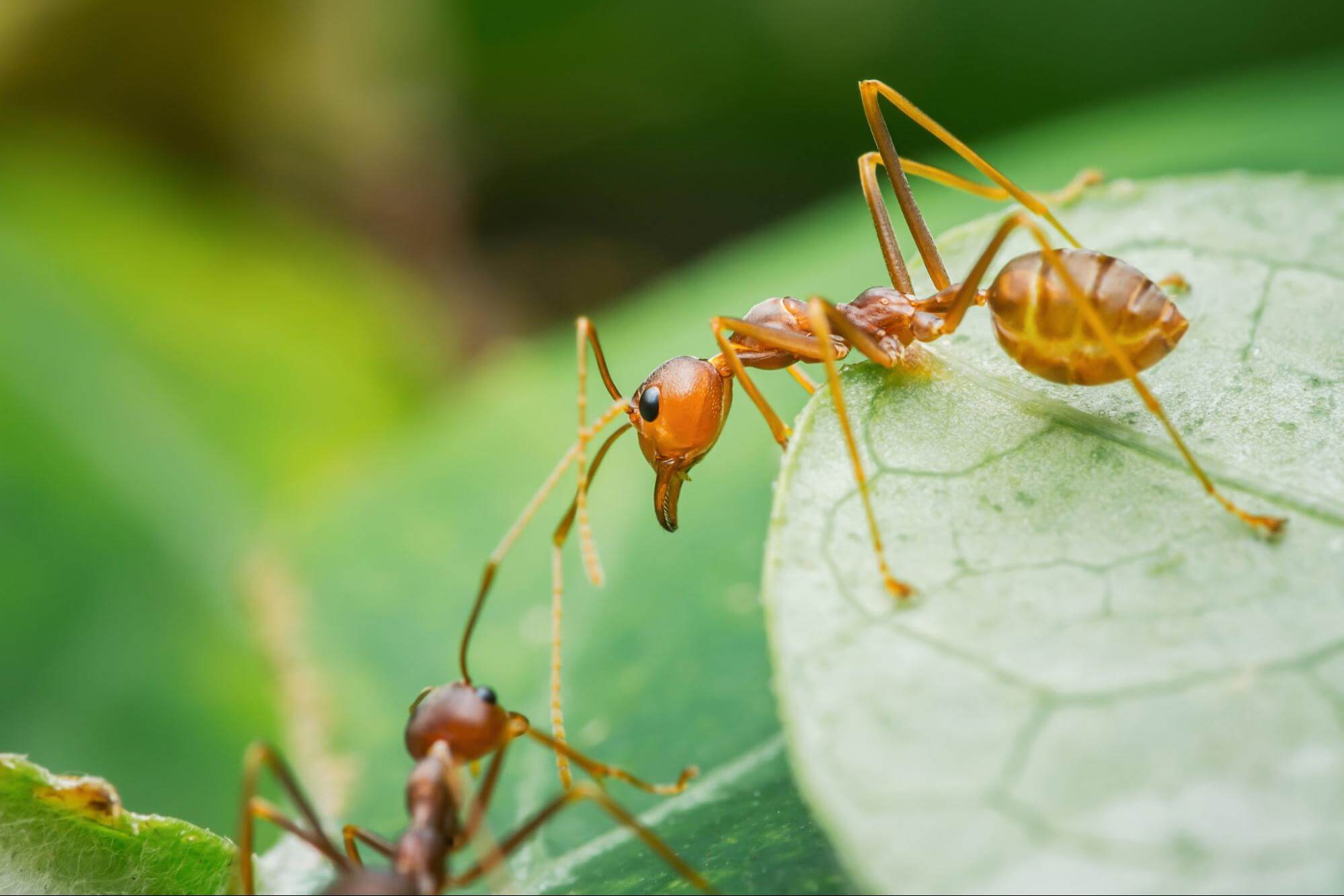
A foraging ant that finds food doesn’t report back. It votes.
Trail pheromone is deposited on the return trip, dropped “in a blotch-like fashion” along the route, and the critical detail is that the amount is not fixed. Research by Traniello found that “the more rewarding a food source is, the higher the concentration of the trail produced.” Earlier work by Wilson and Pavan established that food quality, quantity, and distance from the nest all affect how strong a trail becomes.
Every ant that follows the trail and finds the food still there reinforces it on the way home. Every ant that arrives to find nothing doesn’t. The trail becomes a running tally of how good the food source currently is, maintained by thousands of independent deposits with no coordination from above.
It also explains how trails end. Blum’s work showed that once the food is gone, returning foragers stop renewing the trail, the pheromone diffuses into the air, and the signal decays. A trail is not a road. It’s a continuously renewed opinion, and it disappears the moment the opinion changes.
Why Wiping the Trail Doesn’t Solve Anything
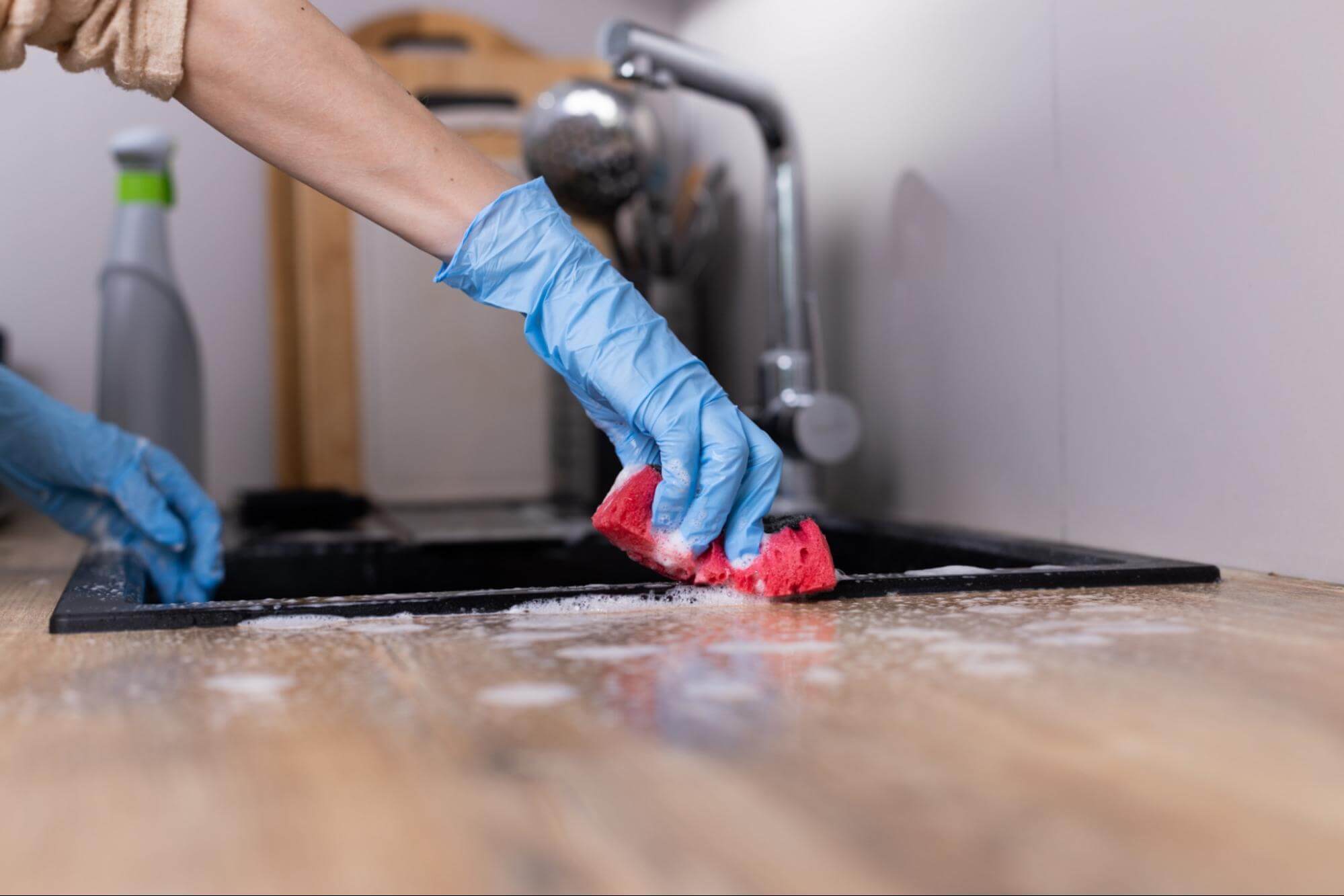
Cleaning the trail is worth doing. UC Integrated Pest Management recommends exactly that: “Clean up invading ants with a sponge and soapy water as soon as they enter to remove the scent trail they leave behind.” It stops the traffic in front of you.
What it doesn’t do is touch the colony. UC IPM puts the reason in one line: “Typically the foragers represent only a small proportion of the colony.”
The ants you can see are a scouting and retrieval crew. The queens, brood, and the overwhelming majority of workers never leave the nest and never encounter your sponge. Remove the trail and the colony simply re-scouts. The food is still there, the entry point is still open, and a new trail gets laid within hours.
Alarm Pheromones, and Why Crushing Ants Backfires
Ants also broadcast threat. Alarm pheromones come from a different glandular system than trail pheromones, and a worker that is crushed, cornered, or attacked releases them immediately. Depending on the species, nearby workers respond by converging on the threat or by scattering away from it.
Neither outcome helps you. Swatting a line of ants on the counter floods that spot with alarm signals, and the common result is that foraging shifts to a different route into the same room – which is why people often report that the ants “moved” after they cleaned up.
The ants didn’t move. The colony rerouted.
Chemical ID Badges: Cuticular Hydrocarbons
Ants recognize each other with a layer of waxy compounds on their exoskeletons. A 2020 review in Frontiers in Ecology and Evolution by Adams and colleagues describes nestmate recognition as based on “signature mixtures of branched and unsaturated cuticular hydrocarbons (CHCs),” and states that “CHC signals are central to the social organization of an ant colony.”
These compounds aren’t volatile the way trail pheromone is. The same review notes they “primarily function in short-range communication” – which is why ants touch antennae when they meet. That contact is an ID check.
The system is good enough that the main way to defeat it is forgery. The review describes social parasites infiltrating colonies as a “wolf in sheep’s clothing using a CHC-based chemical disguise” – counterfeiting the colony’s chemical badge to live inside the nest unchallenged.
The Nest Has Chemical Street Signs Too
The signaling doesn’t stop at the entrance. A 2017 study in Nature Communications by Heyman and colleagues found that carpenter ants navigating a completely dark nest orient using chemical markers on the floor itself. When the researchers shuffled floor segments into a new nest layout, ants returned to the same floor segments rather than the same chambers – the position information was in the surface, not the architecture. Rinsing the floors with solvent erased the effect.
The authors identified “six different chemical profiles that signify different chamber functions within and around the nest.” The most striking result: when given a choice between differently marked chambers, nurses and foragers went opposite ways. Different castes read the same chemical map differently and sorted themselves accordingly.
A colony isn’t just chemically coordinated. It’s chemically zoned.
Why Bait Works and Spray Doesn’t
All of this converges on one practical conclusion. UC IPM is direct about the failure mode: “Spraying around the foundation won’t provide permanent control, because it kills only foraging ants without killing the colony and the queens.” You are treating the small visible fraction and leaving the reproductive core untouched.
Bait inverts the approach. It recruits the colony’s own logistics against it. A worker carries bait home, and through trophallaxis “it is transferred mouth to mouth” to other workers, to larvae, and to queens. The toxicant has to be slow-acting on purpose – fast enough to kill the forager at the bait station, and the chain breaks before it reaches the nest.
This is why patience is part of the method. UC IPM notes it “can take 5 to 10 days to see fewer ants,” and complete control “may take several weeks or more.” For pharaoh ants, AgriLife says baiting can run several months to a year.
And with some species, spraying is actively counterproductive. AgriLife advises against repellent liquid and dust insecticides indoors for pharaoh ants because they “typically cause colony budding, which exacerbates the problem.”
Budding means the colony splits – queens leave with escorts of workers and establish new satellite nests elsewhere in the structure. One nest becomes four, in places nobody has found yet. That’s the worst possible outcome from a can of spray, and it’s a documented one.
What This Means in a North Texas Home
AgriLife’s household ant guide for Texas covers red imported fire ants, carpenter ants, acrobat ants, pharaoh ants, crazy ants, odorous house ants, dark rover ants, and leaf-cutting ants. They nest in different places, forage on different schedules, and respond to different baits – carpenter ants, for instance, are largely nocturnal and trail along fences, limbs, and hoses.
Identification drives everything downstream. AgriLife’s own recommendation is blunt: “In many cases, the best way to confirm the identity of an ant is to enlist the help of a pest management professional.”
Fire ants are the exception that proves the point – they’re an outdoor, mound-building problem on a completely different treatment calendar, which is why the fire ant bait window matters so much. Same family, different playbook entirely.
Ant Communication FAQs
How do ants communicate with each other?
Primarily through pheromones produced by specialized glands – trail pheromones to mark routes to food, alarm pheromones to signal threats, and cuticular hydrocarbons that act as a colony ID badge. They also use antennae contact, vibrations, and mouth-to-mouth food sharing called trophallaxis.
Does wiping up an ant trail get rid of ants?
It removes the scent trail and stops traffic temporarily, which is worth doing. It doesn’t affect the colony. Foragers are only a small proportion of the colony, so the queens and the bulk of the workers remain untouched, and a new trail is laid within hours.
Why doesn’t ant spray work?
Spraying kills foraging ants without reaching the queens, so the colony keeps producing replacements. With some multi-queen species, repellent sprays are worse than useless – Texas A&M AgriLife warns they typically cause colony budding, splitting one nest into several.
How long does ant bait take to work?
Expect 5 to 10 days before ant numbers visibly drop, and several weeks for full control. Difficult multi-queen species like pharaoh ants can take months. The bait is intentionally slow-acting so workers survive long enough to carry it back and share it with the colony.
Treat the Colony, Not the Trail
The ants on your counter are a symptom with a return address. Finding it – and knowing which species you’re dealing with, because the bait depends on it – is the difference between a month of wiping counters and a solved problem.
Red Pest Control provides ant control for homes and commercial properties across Fort Worth, Dallas, Arlington, and the greater DFW Metroplex, with same-day service available. Every property gets an assigned technician who learns the building – which species is active, where the nest is, and what keeps drawing them back. Our treatments are family and pet safe, we’re fully licensed and insured, and we work on a handshake with no contracts. We don’t just treat symptoms. We solve the problem at its source.
Call 817.865.5251 or request a free quote.
Already working through your fall pest checklist? Ant trails are one of the easiest things to spot while you’re inspecting the perimeter.