
The Biology of Termite Swarms: Why Termite Swarmers Take Flight When They Do
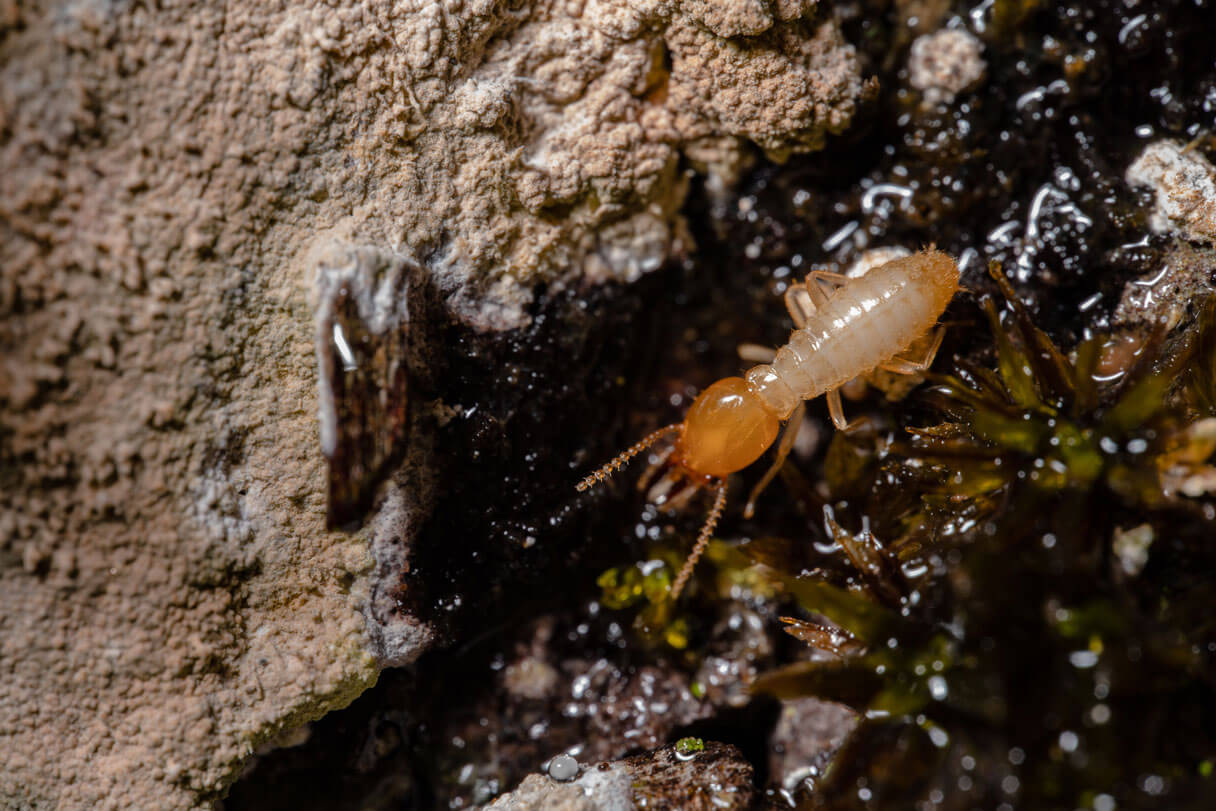
Most people meet their first termite as a small pile of translucent wings on a windowsill.
No insects. Just wings – identical, pale, roughly the length of a grain of rice, collected in the corner where the glass meets the frame. It’s an odd thing to find, and it’s easy to sweep up and forget.
It shouldn’t be. Those wings are the most reliable early warning a homeowner gets, and the biology behind them explains why. Termite swarmers don’t emerge at random, they don’t emerge from young colonies, and they don’t travel far. Understanding what triggers the flight tells you a great deal about what’s happening near your house.
What a Termite Swarmer Actually Is
A termite colony runs on a caste system. Texas A&M AgriLife identifies four: reproductives, soldiers, workers, and nymphs.
Workers do essentially everything – foraging, feeding, tunneling, tending brood. They’re blind and wingless and make up the bulk of the population. Soldiers, with their enlarged heads and mandibles, exist only for defense and account for “only one to five percent of the total population.”
Swarmers are the third path. Formally called alates, they’re winged primary reproductives – the only caste built to leave. AgriLife describes them as “about 1/4 to 3/8 inch long,” with bodies ranging “from coal black to pale yellow-brown” and wings carrying distinct vein patterns.
An alate has one job: get out, find a mate from another colony, and start a new one. Everything about its body is built for a single flight that lasts minutes.
A Swarm Means the Colony Is Already Mature
This is the part that matters most, and it’s the part almost no one explains.
A colony cannot produce alates until it’s large and stable enough to spare them. AgriLife puts that at roughly two to four years before a subterranean colony matures enough to produce swarmers, and a mature native colony “can contain as many as 250,000 workers.”
Run that backward. A swarm is not the beginning of a termite problem – it’s the announcement of one that’s been underway for years. By the time you see winged termites, workers have been feeding somewhere nearby, out of sight, through multiple seasons.
Swarmers are a lagging indicator. That’s exactly why they’re worth taking seriously.
What Triggers the Flight
Alates don’t decide to leave. Conditions decide for them.
AgriLife is specific: “Heat, light, and moisture trigger the emergence of swarmers, with each species having its own set of requirements.” The classic combination is a warm day following rain – soil temperature up, humidity high, ground soft.
The synchronization is the clever part. A lone alate that emerges on a random Tuesday has almost no chance of finding a mate. By responding to shared environmental cues, every mature colony in an area releases at roughly the same moment, which floods the neighborhood with reproductives from many different colonies at once. That’s what makes cross-colony pairing possible, and it’s why a swarm looks like an event rather than a trickle.
High humidity matters for a second reason. Alates are soft-bodied and desiccate quickly. Flying into dry air is fatal, so the moisture window isn’t just convenient – it’s the only survivable one.
When Termite Swarmers Appear in Texas
Timing depends on both species and region, which is why generic advice misses.
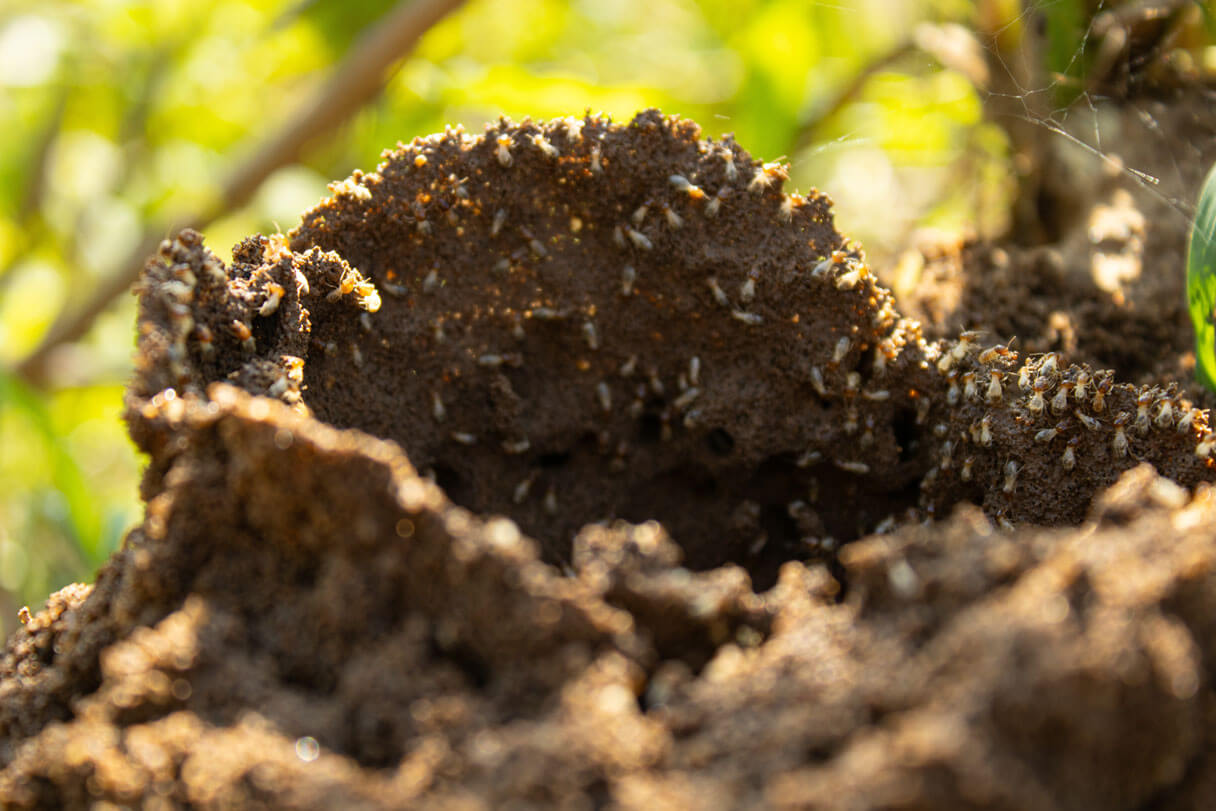
Subterranean termites, the most economically significant group in North Texas, swarm in spring. AgriLife notes that swarming “begins in South Texas in January and February. In the Panhandle region of Texas, swarms do not occur until April or May.” DFW sits between those, generally February through April, usually in daylight after rain.
Drywood termites run on a different calendar entirely. AgriLife reports they’re “found throughout Texas, with the highest concentrations along the Gulf Coast,” and that they swarm in late August and early September. Unlike subterraneans, they “live in sound, dry wood above ground level” and “need no contact with soil” – meaning attics, trim, and furniture rather than the foundation.
Formosan termites, an aggressive introduced subterranean species, swarm at night in late spring and are strongly drawn to lights.
So a late-September find in North Texas is most likely drywood activity or the residue of an earlier subterranean flight – and either one is worth identifying rather than sweeping up.
The First 24 Hours of a New Colony
What happens after landing is brief and brutal.
An alate that survives the flight sheds its wings almost immediately – they detach along a built-in fracture line, which is why you find loose wings and no bodies. The wingless termite is now a dealate, and it goes looking for a partner.
Once paired, AgriLife describes the sequence: the pair “shed their wings, dig a nuptial chamber in moist soil near wood, and mate.” They become the king and queen of a colony that starts as two insects in a chamber smaller than a fingernail. The first brood is tiny, and the founding pair tends it themselves – the only point in a colony’s life when reproductives do manual labor.
The overwhelming majority never get that far. Most alates are eaten, dry out, or fail to find a mate within hours. A swarm of thousands might produce a handful of surviving colonies. The strategy is volume, not odds.
Swarm or Infestation? How to Tell
Not every swarm means your house is being eaten. There’s a clear dividing line.
Mississippi State University Extension puts the threshold at distance and origin. Swarmers emerging inside – “directly from the structure itself (walls, ceiling, floors, etc.)” – or large numbers of swarmers and piles of wings indoors indicate “there is a termite infestation somewhere nearby.”
By contrast, swarmers emerging outdoors “well away from the foundation of the building (25 feet or more)” are “rarely a cause for concern.” Termites recycling a dead stump at the back of the lot are doing the job they evolved for.
The 25-foot rule is the practical takeaway. Where the swarm came from matters far more than how big it was.
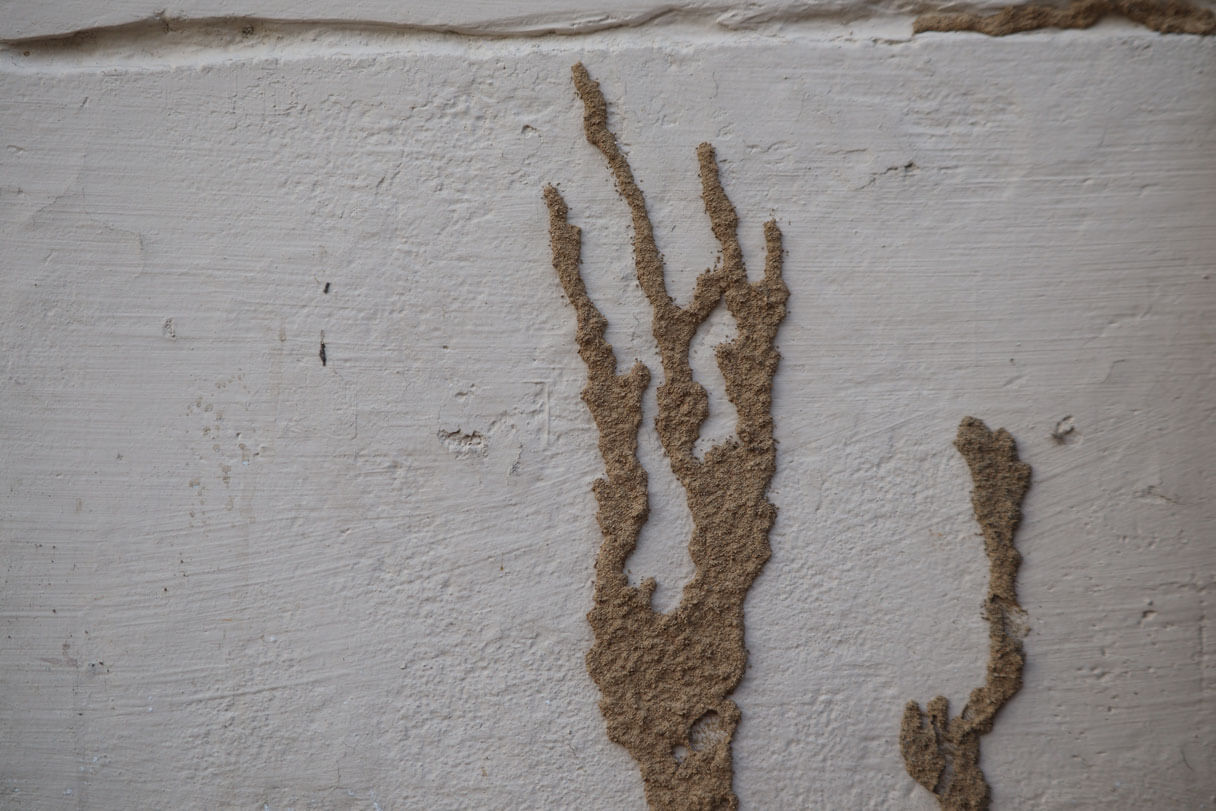
Two other signs carry the same weight: mud tubes running up a foundation or through a crawl space, which MSU calls “usually a sure sign that a building is infested,” and fecal pellets – drywood termites produce hard six-sided pellets about 1/32 inch long, “blunt at one end and pointed at the other,” which AgriLife notes are “unique to drywood termites.”
Termite Swarmers vs. Flying Ants
They swarm in the same weather, and they get confused constantly. Three features separate them, per University of Maryland Extension:
- Antennae – termites have “straight antennae”; ants have “elbowed antennae”
- Waist – a termite’s “body extends straight back from head,” with no pinch; ants have a “pinched or ‘wasp-waist’”
- Wings – termite wings are “similar in shape and/or equal length, pale, translucent”; ant wings have “front wings longer than hind wings, tinted brown”
The wing test is easiest on a windowsill find. Four wings of equal length and colorless means termite. Two long and two short, with a brownish tint, means ant.
AgriLife notes the two “often swarm at about the same time of year, but control measures for each differ greatly.” Getting the ID right determines the entire response.
What to Do If You Find Swarmers or Wings
Don’t spray them. This is the most common reaction and the least useful one. Alates are the one caste that has already left the colony. Killing every swarmer in the room does nothing to the 250,000 workers still feeding, and it destroys the evidence.
Instead:
- Collect a few in a sealed bag or jar – including wings. Identification determines species, and species determines treatment.
- Note exactly where they came from – a specific window, a wall seam, a light fixture, an expansion joint. That location is the starting point of an inspection.
- Leave the area undisturbed rather than cleaning it up before anyone sees it.
- Check the foundation and crawl space for mud tubes, and the attic for pellets. While you’re in the crawl space, it’s worth looking for the rodent entry points that open up this time of year too.
- Schedule an inspection. A swarm indoors means a mature colony, and colony-level treatment is not a retail-shelf product.
Why This Matters in North Texas
AgriLife estimates termites cause approximately $500 million in damage each year in Texas alone. Termite damage is also excluded from most standard homeowners policies, which means the repair bill is typically yours.
The compounding problem is time. A colony large enough to swarm has been feeding for years, and the damage curve steepens as the colony grows. The gap between “we found it at the swarm” and “we found it when the trim gave way” is usually measured in thousands of dollars.
Fall is a sensible time to get this looked at. Subterranean swarm season is still months away, which means an inspection now is a planning exercise rather than an emergency call.
Termite Swarmer FAQs
What does it mean if I find termite wings in my house?
It means winged reproductives landed and shed their wings nearby. Because colonies need roughly two to four years of growth before producing swarmers, discarded wings indoors point to an established colony close to or inside the structure.
When do termites swarm in Texas?
Subterranean termites swarm in spring – January and February in South Texas, April and May in the Panhandle, with North Texas generally falling between. Drywood termites swarm separately in late August and early September.
Are termite swarmers dangerous?
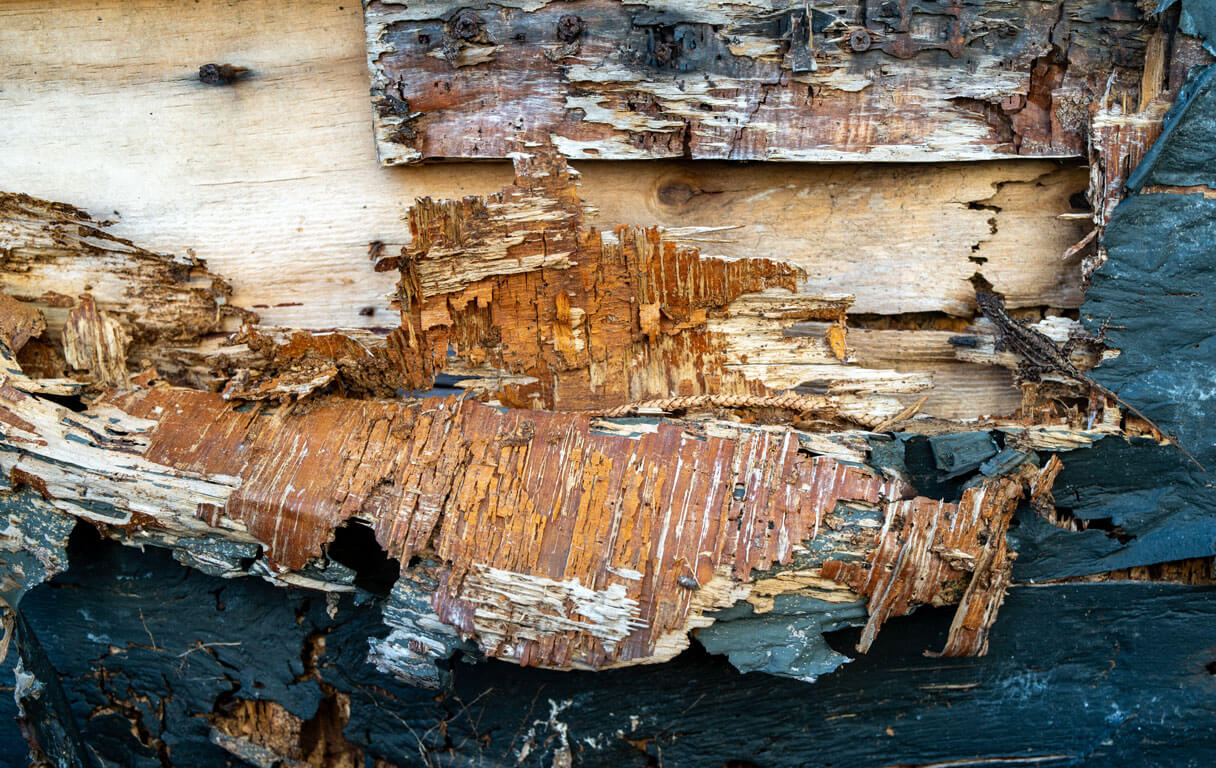
Not to people. Swarmers don’t bite, sting, or feed on wood – they exist only to reproduce, and most die within a day. The damage comes from the worker caste in the colony they came from.
Should I spray termite swarmers?
No. Swarmers have already left the colony, so killing them has no effect on the termites causing damage. It also destroys the evidence needed for identification. Collect a sample, note where they emerged, and get an inspection.
Get It Identified Before the Damage Compounds
A pile of wings on a windowsill is a small thing that answers a large question. Finding out which species, and where they came from, takes an inspection – not a can of spray.
Red Pest Control provides termite control and inspections across Fort Worth, Dallas, Arlington, and the greater DFW Metroplex, with same-day service available. Every property gets an assigned technician who learns your home – where the conducive conditions are, which grade or moisture issue keeps inviting activity back, and what changes season to season. Our treatments are family and pet safe, we’re fully licensed and insured, and we work on a handshake with no contracts. We don’t just treat symptoms. We solve the problem at its source.
Call 817.865.5251 or request a free quote and we’ll take a look before spring swarm season arrives.